For someone living in a city, a cancer screening test might feel like a simple appointment on a calendar.
For someone in a remote village, it can mean taking a day off work, arranging transport, travelling several kilometres, finding the right healthcare facility and then figuring out what to do next.
That distance – physical, financial and sometimes even informational- can make the difference between finding cancer early and finding it much later.
This is why cancer screening programs in rural India matter so deeply. They are not simply about conducting tests. They are about taking the first step of cancer care closer to the people who need it.
And increasingly, technology and telemedicine are helping to make that possible.
Cancer does not always announce itself.
Sometimes cancers might develop with few or no visible symptoms in their early stages. Screening helps identify possible disease or precancerous changes before a person feels seriously unwell, creating an opportunity for timely diagnosis and treatment.
In India, population-based screening has particularly focused on three common cancers- oral, breast and cervical cancer – alongside other major non-communicable diseases such as diabetes and hypertension. The national programme is designed to bring screening and referral closer to communities through primary healthcare systems.
That shift is important.
Because the question should not always be, “Can the patient reach the hospital?”
Sometimes, it should be, “How much closer can healthcare come to the patient?”
In many rural and underserved communities, cancer care is challenged by more than a shortage of specialists.
There can be:
For a person who depends on daily wages, travelling to a distant hospital for a screening appointment may mean losing a day’s income. For an older adult, it may mean depending on someone else for transport. For women, social and logistical barriers can make preventive screening even more difficult.
This is where NCD screening programs in India are playing an important role.
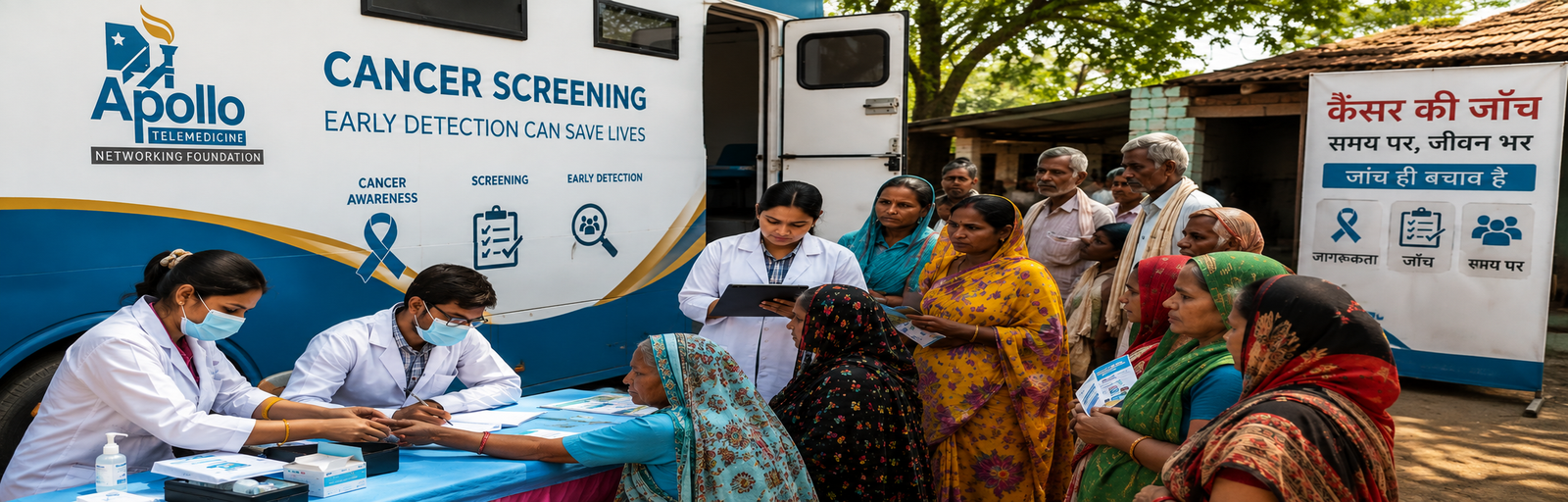
By bringing screening closer to communities through health centres, outreach camps, frontline health workers and mobile healthcare services, preventive care can become part of everyday primary healthcare rather than something people seek only when illness becomes difficult to ignore.
Screening is only the beginning.
Once a person is identified as being at risk or requiring further evaluation, the next steps – clinical assessment, referral, specialist consultation and follow-up – become equally important.
This is where cancer screening and telemedicine can work together.
A community-level screening initiative can identify a person who needs further attention. Technology can then help connect that individual or the local healthcare team with specialists who may be located many kilometres away.
The result is a more connected pathway:
Community → Screening → Specialist consultation → Referral → Follow-up
Instead of making patients navigate this journey alone, technology can help connect different points of care.
For rural India, that connection can be transformative.
At Apollo Telemedicine Networking Foundation (ATNF), community healthcare models combine outreach with technology to take healthcare closer to underserved populations.
Through models such as Mobile Medical Units, healthcare teams can conduct NCD screening camps, provide consultations, support cancer awareness and screening, maintain electronic health records, and enable follow-up teleconsultations.
ATNF’s work also includes cancer screening initiatives across geographies, including a successful cancer screening programme in Meghalaya.
Explore ATNF’s Community Healthcare Services →
The value of such programmes goes beyond the screening camp itself.
A screening camp may last a few hours. But for the person whose health concern is identified that day, it can be the beginning of a much longer journey toward diagnosis, treatment and care.
One of the biggest changes needed in rural cancer care is moving from awareness to action.
Knowing that cancer screening is important is one thing.
Getting screened is another.
That is why effective programmes need:
India’s population-based screening programme itself emphasises screening, early detection, referral and continuity of care through primary healthcare and higher-level facilities.
Recent national efforts show the scale at which this approach is growing. As of March 2026, the Government of India reported 8.73 crore women screened for cervical cancer, with 93,062 cases diagnosed under the NP-NCD programme.
Someone who may have otherwise never known that something needed attention.
The success of cancer screening programs in rural India should not only be measured by how many people were screened.
It should also be measured by what happens next:
These are the connections that turn screening into meaningful healthcare.
Because early detection is valuable only when it leads to timely action.
India’s healthcare journey is increasingly moving towards a model where technology does not replace human care, it extends its reach.
Together, these pieces can create something much bigger than a screening programme: a healthcare pathway that follows the patient, rather than expecting the patient to overcome every barrier alone.
For rural India, that could mean fewer missed opportunities for early detection and more people getting the chance to act before a health concern becomes a crisis.
Because sometimes, saving a life begins with something as simple as bringing the right screening test a little closer to home.
Want to explore how technology-enabled community healthcare can improve access to preventive and primary care?